Living with pain changes how you sleep, work and move through your day. Ayurveda for pain starts with the whole picture, so your digestion and stress levels matter as much as the sore knee or aching back. This guide explains how Ayurveda reads pain, what current research shows, and how you can use it safely alongside your medical care.
How Ayurveda views pain
Ayurveda sees pain as a sign that the body’s principle of movement (Vata dosha) has fallen out of balance. Classical texts use several words for it, including the sensation of pain (vedana) and sharp, piercing pain (shoola). The old teaching that no pain arises without Vata still anchors modern Ayurvedic writing, including a 2025 review of vedana in the Journal of Ayurveda and Integrated Medical Sciences.
But Vata rarely works alone. The fire principle (Pitta dosha) adds heat and burning, while the earth and water principle (Kapha dosha) adds heaviness, swelling and stiffness. Ayurveda also looks for undigested residue (ama), which builds up when your digestive fire (agni) is low and can clog the body’s channels (srotas).
This is why two people with the same scan can leave an Ayurvedic consultation with different plans. Your inborn constitution (prakriti) and current imbalance (vikriti) both shape the advice.
Vata, Pitta and Kapha pain compared
Each dosha leaves a recognisable signature on pain. Use this table to start a conversation with your practitioner, not to self-diagnose.
Pain conditions and their Ayurvedic names
Ayurveda gives each pain pattern its own name, and knowing these names helps you follow your practitioner’s explanation. Many people search for Ayurveda for body pain without realising sore joints and a stiff back may sit in different categories. The table pairs common diagnoses with their Ayurvedic names.
Two of these names appear often in current research. Knee osteoarthritis maps closely to joint-centred Vata disorder (Sandhigata Vata). A 2025 trial protocol for a multimodal Ayurveda regimen in knee osteoarthritis planned to compare a full Ayurvedic programme with standard care in 150 adults. Rheumatoid arthritis sits closest to Amavata, where ama travels with Vata into the joints.
The Amavata research shows both promise and limits. In a 2025 University of Colombo trial of Rasna decoctions for Amavata, 60 inpatients reported marked symptom relief over 14 days. Their inflammatory blood markers did not change significantly. This is why we see Ayurveda as a partner to rheumatology care rather than a replacement.
Sciatica (Gridhrasi) takes its name from the Sanskrit word for vulture, after the stiff and dragging walk it can cause. This is explained in a 2025 review of Gridhrasi in the Ayurvedic classics. Knowing your pattern also helps when you compare Ayurveda with other traditional systems.
Ayurveda vs Traditional Chinese Medicine, acupuncture and naturopathy for pain
All three systems share a whole-person view of pain but differ in their tools, research base, and how Australia regulates them. Traditional Chinese Medicine sees pain as a blockage in the flow of vital energy (qi) and blood. Naturopathy uses western herbs and nutrition to support the body’s repair.
Acupuncture has the largest trials for chronic back pain. A 2025 JAMA Network Open trial of acupuncture for chronic low back pain followed 800 adults aged 65 and over. It found less back-related disability at 6 and 12 months than usual medical care alone. Serious side effects were rare.
Regulation differs too. Traditional Chinese Medicine practitioners are nationally registered, with 4,898 on the register in the Chinese Medicine Board of Australia 2024/25 annual summary. Naturopathy and western herbalism became eligible for private health insurance benefits again from 1 July 2025 under Department of Health circular PHI 51/25. Ayurvedic practitioners are outside national registration, so professional associations set their standards.
The table sums up the main differences.
You do not have to choose only one system. Tell each practitioner about every herb and medicine you take because mixing herbal traditions without coordination raises the risk of interactions. When you choose an Ayurvedic practitioner, ask about their qualifications. Our doctors hold a Bachelor of Ayurvedic Medicine and Surgery (BAMS) and belong to the Australasian Association of Ayurveda.
Ayurveda alongside medical cannabis and other options for chronic pain
Ayurveda can sit alongside medical cannabis and conventional pain care, provided your GP and Ayurvedic practitioner both know the full picture. Medical cannabis use has grown fast here, with nearly a million prescribing approvals granted through 2025. This figure comes from an analysis of Therapeutic Goods Administration data by the University of Melbourne.
How Ayurveda fits with your wider care
If you use medical cannabis, Ayurveda can focus on what cannabis does not reach: your sleep, digestion, and daily movement. Some Ayurvedic herbs have calming effects. Your practitioner needs your full medication list before suggesting any formula. Never stop or change a prescribed medicine without your doctor’s advice.
Good pain care often draws on several professions. Physiotherapy, pain psychology and GP review all have a place, and Ayurveda adds attention to food and routine.
Signs that need medical care first
Some symptoms need medical assessment before starting any traditional therapy. See your GP promptly or call 000 in an emergency if you notice any of these:
- New numbness or weakness in your legs or arms
- Loss of bladder or bowel control
- Pain with fever or unexplained weight loss
- Sudden severe pain after a fall or injury
- Chest pain or pain spreading to your jaw or arm
Ayurvedic herbs for pain relief
The Ayurvedic herbs for pain relief with the most research are Boswellia (Shallaki), turmeric (Haridra) and ginger (Shunthi). A 2025 network meta-analysis in Nutrients co-authored by RMIT University researchers pooled 39 trials with 4,599 people living with knee osteoarthritis. Boswellia ranked highest for easing pain and stiffness, while curcumin and ginger helped some outcomes. Side effects were no more common with any supplement than with a dummy pill.
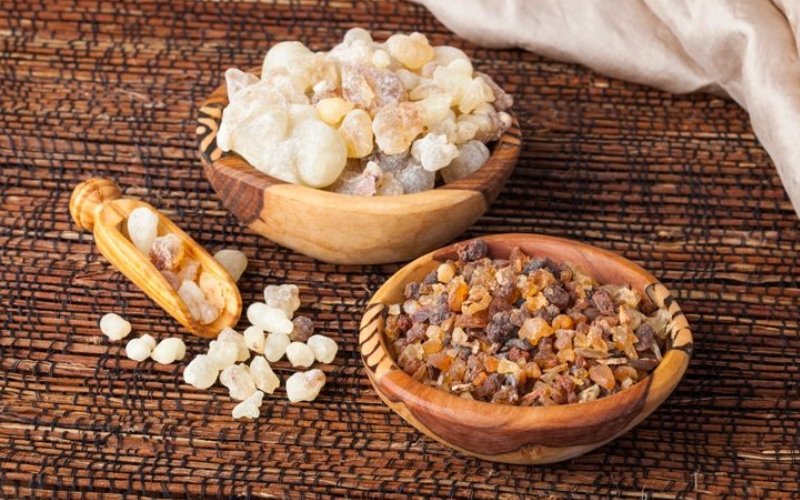
Boswellia’s wider research base is still young. A 2025 systematic review in Traditional and Integrative Medicine analysed 49 randomised trials, including 12 in osteoarthritis, and described Boswellia as a possible complementary treatment needing larger studies.
Turmeric needs a more careful reading. A 2026 umbrella review of curcumin for knee osteoarthritis in Frontiers in Pharmacology rated all seven included reviews as critically low quality, even though most pointed to less pain.
Traditional formulas add another layer. A 2025 randomised study of Trayodasanga Guggulu and Sahacaradi oil found the oral resin formula and topical oil gave comparable results for knee osteoarthritis.
The table summarises the herbs you are most likely to come across.
Safety comes first with herbal medicine
“Natural” does not mean risk-free. Health Canada’s 2025 summary safety review of turmeric and curcuminoids linked oral turmeric supplements to rare liver injury and called for label warnings. Cooking with turmeric in everyday meals fell outside that warning.
Ashwagandha carries a similar caution. In 2025, the Dutch pharmacovigilance centre Lareb recorded 12 people with liver damage linked to ashwagandha. German risk assessors advise pregnant or breastfeeding women and children to avoid it. People with a history of liver trouble should avoid it too, as summarised in arznei-telegramm’s 2025 report on ashwagandha and liver damage.
Product quality matters as much as the herb. New Zealand testing found heavy metals such as lead or mercury in 58 of 75 Ayurvedic medicines on sale, and 13 products were removed from the market. By May 2025, the country logged 22 cases of raised blood lead levels linked to these medicines, detailed in bpac NZ’s 2025 guide to lead toxicity from Ayurvedic medicines.
Whenever you choose an Ayurvedic medicine for pain relief in Australia, look for an AUST L or AUST R number on the label. That number shows the product is on the Australian Register of Therapeutic Goods. Avoid importing mineral-based preparations (rasa shastra) for personal use, and tell your GP about every herbal product you take.
Diet and nutrition for pain management
Ayurvedic eating for pain centres on warm, freshly cooked meals that keep your digestive fire steady and prevent ama from building up. Modern nutrition science points in a similar direction. A 2026 narrative review of anti-inflammatory diets and chronic pain in Quality in Sport found plates heavy in produce and wholegrains, with legumes and oily fish, were linked to calmer inflammation and somewhat lower pain scores.
A 2025 systematic review of the Mediterranean diet in fibromyalgia also tied closer adherence to less widespread pain and fatigue.
Eating based on your dosha
The table shows how the same healthy foundation shifts for each dosha.
Kitchen habits that support comfort
A few simple habits carry most of the benefit. Try building these into your week:
- Eat your main meal at midday, when Ayurveda considers digestion strongest.
- Sip warm water or ginger tea through the day instead of iced drinks.
- Cook with turmeric, cumin and black pepper as everyday spices rather than relying on concentrated capsules.
- Try a simple kitchari of rice and mung dal when your digestion feels heavy.
- Follow the seasonal routine (ritucharya) using Australian seasons, so the cool and windy months become your Vata season.
Ayurvedic treatment for pain management
Ayurvedic treatment for pain management begins with a consultation then blends herbs and diet with hands-on therapies matched to your dosha pattern.
Your first consultation
At your first visit, your Ayurvedic doctor reads your pulse (nadi pariksha) and looks at your tongue. They also ask about your digestion, sleep, stress, and any scans or medicines from your GP. Your doctor will suggest Ayurvedic medicine for pain relief only once they know your full medication list.
Oil massage and herbal heat therapies
Warm oil and gentle heat are central to Ayurveda pain relief for Vata-type aches. Therapeutic full-body oil massage (Abhyanga) uses warm medicated oils. Herbal steam (Swedana) often follows to relax tight tissues. Herbal pouch massage (Kizhi, also called Pinda Sweda) presses warm cloth bundles of herbs rhythmically over sore areas. At our clinic each pouch holds 18 therapeutic herbs.
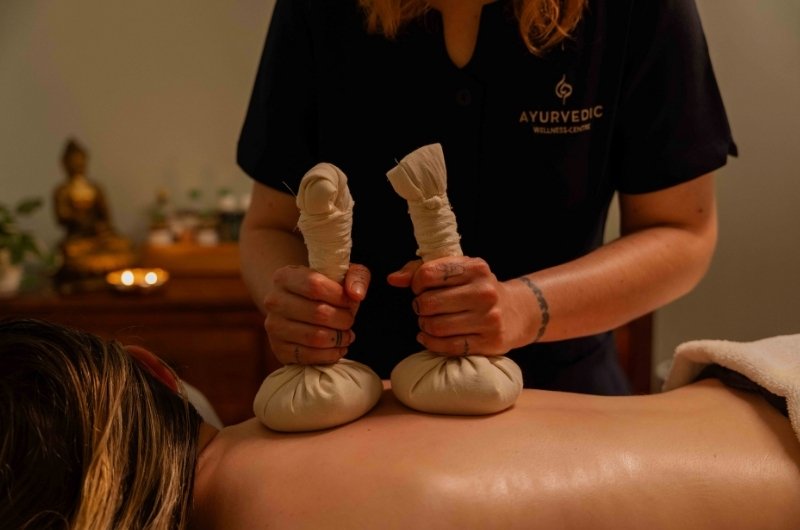
When people ask us about Ayurveda for body pain that shifts and worsens with cold, this is usually where we begin. These therapies have a long traditional record but few large modern trials. Think of them as supportive care rather than a stand-alone fix.
Localised oil therapies
For one painful area, a ring of black gram dough holds warm medicated oil over the spot for a set time. This is called Kati Basti for the lower back, Janu Basti for the knee and Greeva Basti for the neck. Small studies are building evidence, including a 2025 comparison of Kati Basti and an oil-soaked cotton pad (Kati Pichu) for sciatica in 30 people. Larger controlled trials are still needed.
Panchakarma and medicated enema
Panchakarma is a structured cleansing programme of five classical procedures. An Ayurvedic doctor should prescribe it only after a full assessment. Medicated enema (Basti) is the procedure Ayurveda regards as most important for Vata conditions, including chronic back pain. In a 2025 single-arm trial of Panchaprasrutik Basti for low back pain, 35 participants showed significant improvement after seven days.
That study had no comparison group, so its results call for further research rather than proof. Panchakarma is also unsuitable during pregnancy or when you are frail or acutely unwell.
Daily routine, yoga and breathwork
Daily routine (dinacharya) is where long-term Ayurveda pain relief takes shape between appointments. A morning self-massage with warm sesame oil and a regular bedtime help settle Vata. Gentle yoga and slow breathing (pranayama) keep joints moving. Yoga is also among therapies eligible for private health insurance benefits again from July 2025, so check your extras cover.
Finding gentle, lasting support for your pain
In our experience, people do best when they pair their medical team with Ayurveda’s attention to food, routine, and touch. Ayurveda for pain is not a quick fix. No honest practitioner will promise you a cure. What it offers is a patient and personal plan that respects your body and your other treatments.
If you would like guidance, our Ayurvedic doctors at Ayurvedic Wellness Centre in Bondi Junction can assess your dosha pattern and work alongside your GP.
The first version of this article was published on February 3, 2017.
Disclosure: This article is general information and is not a substitute for medical advice. Talk to your doctor before starting any herb, especially if you take prescription medicines or have a health condition.
Sources
- Chronic musculoskeletal conditions in Australia – https://www.aihw.gov.au/reports/chronic-musculoskeletal-conditions
- Global traditional medicine strategy 2025-2034 – https://www.who.int/publications/i/item/9789240113176
- A comprehensive review of term Vedana and Vedanasthapana Karma by Padmak (Prunus cerasoides D. Don) in Supti (Sensation Loss) – https://jaims.in/jaims/article/view/4272/
- Efficacy of a Multimodal Ayurveda Regimen in the Management of Primary Knee Osteoarthritis: Protocol for an Open-Label Randomized Controlled Trial – https://www.researchprotocols.org/2025/1/e68306
- A comparative clinical study on the efficacy of Rasna Panchaka and Rasna Saptaka Kwatha with Murungadi Lepa (local application) in the management of Amavata (Rheumatoid Arthritis) – https://archive.cmb.ac.lk/handle/70130/8885
- Unravelling Sciatica: Insights into Gridhrasi from Ayurvedic Classics – https://jaims.in/jaims/article/view/4307/
- Acupuncture for Chronic Low Back Pain in Older Adults: A Randomized Clinical Trial – https://pubmed.ncbi.nlm.nih.gov/40938602/
- Chinese Medicine Board of Australia: 2024/25 annual summary – https://www.chinesemedicineboard.gov.au/News/Annual-report.aspx
- PHI 51/25 Private Health Insurance Legislation Amendment Rules (No. 5) 2025 – https://www.health.gov.au/news/phi-circulars/phi-5125-private-health-insurance-legislation-amendment-rules-no-5-2025
- Medicinal cannabis has gone mainstream. But Australia’s struggling to cope – https://findanexpert.unimelb.edu.au/news/149559-medicinal-cannabis-has-gone-mainstream.-but-australia’s-struggling-to-cope
- Comparative Effectiveness of Nutritional Supplements in the Treatment of Knee Osteoarthritis: A Network Meta-Analysis – https://pmc.ncbi.nlm.nih.gov/articles/PMC12348802/
- Therapeutic Effects of Boswellia in Different Diseases: A Systematic Review on Human Studies – https://jtim.tums.ac.ir/index.php/jtim/article/view/2059
- A critical review of systematic reviews and meta-analyses of curcumin for knee osteoarthritis – https://pmc.ncbi.nlm.nih.gov/articles/PMC12813030/
- Efficacy of Trayodasanga Guggulu and Sahacaradi Taila in Knee Osteoarthritis (Sandhigatavata): A Randomized Controlled Study – https://journals.lww.com/10.4103/ijaim.ijaim_4_25
- Summary Safety Review: Turmeric and Curcuminoids for Oral Use: Assessing the Potential Risk of Hepatotoxicity – https://dhpp.hpfb-dgpsa.ca/review-documents/resource/SSR1758121117867
- Yet again: Ashwagandha and liver damage – https://www.arznei-telegramm.de/html/2025_09/2509809_01.html
- Lead exposure and toxicity associated with Ayurvedic medicines – https://bpac.org.nz/2025/lead.aspx
- Synergistic role of anti-inflammatory diet and physical activity in modulating chronic pain syndromes: a narrative review – https://apcz.umk.pl/QS/article/view/69177
- Mediterranean diet and its low-antigenic and anti-inflammatory properties on fibromyalgia: a systematic review – https://www.iris.unicampus.it/handle/20.500.12610/93737
- A comparative study of the effect of Kati Basti and Kati Pichu with Astakatvar Taila in the management of Gridhrasi w.s.r. to Sciatica – https://jaims.in/jaims/article/view/4365/
- Low Back Pain Management through Bowel Lavage (Panchaprasrutik Basti): A Single Arm Clinical Trial – https://www.jpharmacol.com/article/j-pharmacol-pharmacother-16-4-433